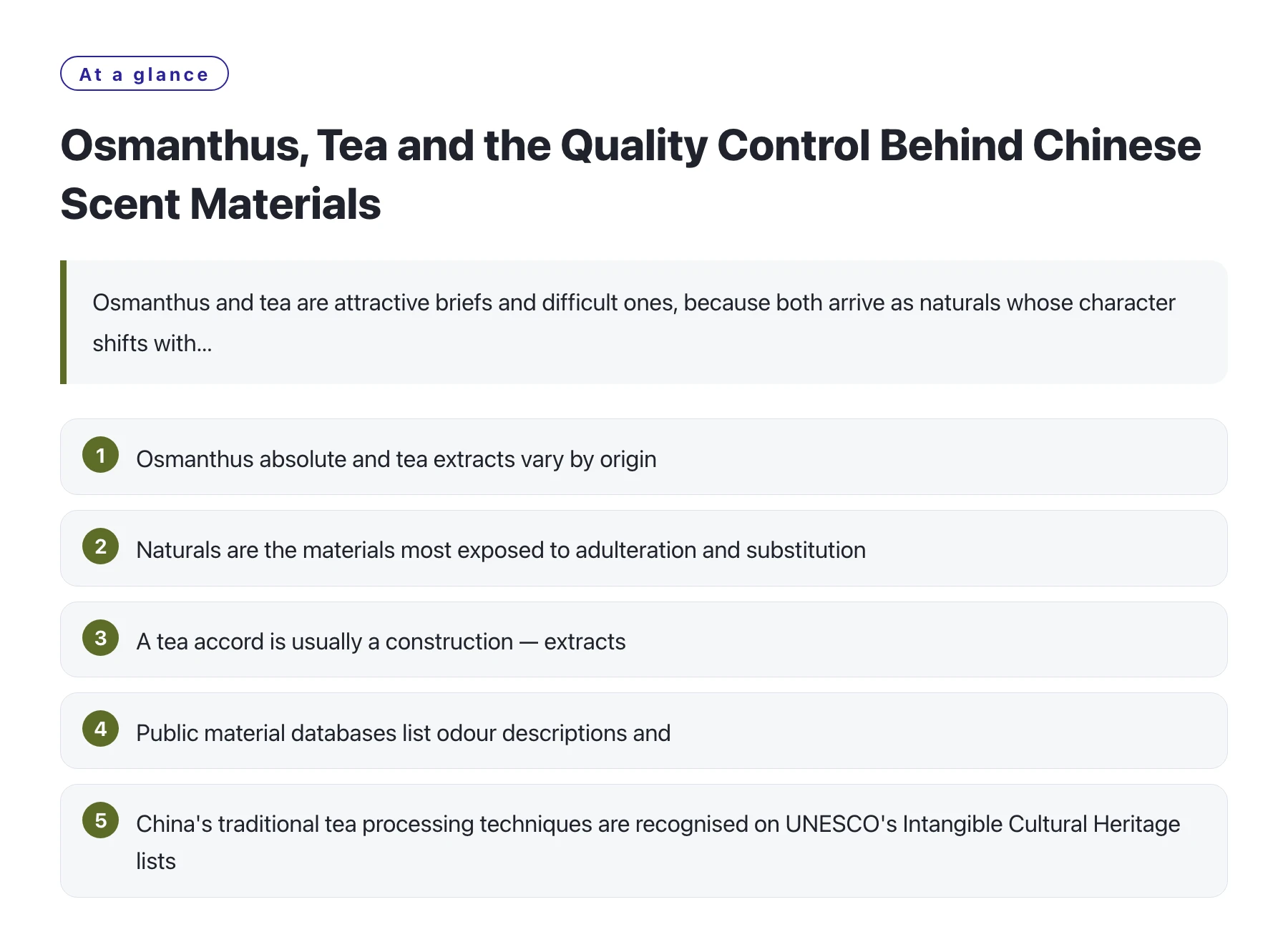
Osmanthus and tea are attractive briefs and difficult ones, because both arrive as naturals whose character shifts with harvest, origin and extraction method. The quality control question is not whether a batch smells good — it is whether the batch smells like the reference, and that requires a specification, a retained sample and an analytical check rather than a nose alone. Brands that treat these materials as fixed inputs rather than variable ones spend the first production run learning that lesson.
Key takeaways
- Osmanthus absolute and tea extracts vary by origin, harvest timing and extraction method, so a specification must define the reference rather than a material name.
- Naturals are the materials most exposed to adulteration and substitution, which is why an analytical check belongs in routine incoming inspection rather than in a one-off audit.
- A tea accord is usually a construction — extracts, absolutes and single molecules — rather than one ingredient, so consistency depends on every component being controlled.
- Public material databases list odour descriptions and, for many materials, recommended use levels, which gives a specification a defensible starting point [1].
- China's traditional tea processing techniques are recognised on UNESCO's Intangible Cultural Heritage lists, which is a legitimate part of the material story rather than a marketing embellishment [2].
A brief that asks for osmanthus or tea is asking for a cultural reference as much as an odour. That is part of the appeal and part of the difficulty: the reference is specific, the materials are variable, and the two do not automatically line up.
This article looks at the materials themselves — what they are in practice, where the variability comes from, and which checkpoints catch a drift before it reaches a finished batch. It is written for buyers who will have to approve a specification, not for perfumers choosing notes.
Two routes to the same idea
There are broadly two ways to build an osmanthus or tea character. The first uses natural derivatives: osmanthus absolute or concrete from a specific origin, and tea derivatives such as absolute, extract or a carbon dioxide extract depending on the effect required. The second reconstructs the effect from single molecules and bases, sometimes with a small proportion of natural material for depth.
Both are legitimate, and they fail differently. Natural-led accords are exposed to harvest variability and cost swings. Reconstructed accords are exposed to the risk that the formula drifts when a base is reformulated by its supplier, and to a different kind of scrutiny from buyers who expect a natural story to contain natural material.
Whichever route is chosen, the specification has to name the route explicitly, because the raw materials behind Chinese scent traditions behave very differently depending on which one is in play — a point that only becomes obvious when a second batch is compared against the first.
Where the variability comes from
Osmanthus is harvested in a short window, and the aromatic profile moves with the timing of the harvest, the weather in the weeks before it, and how quickly the flowers are processed. Two absolutes from the same region in different years can differ noticeably, and absolutes from different regions more so.
Tea materials carry a similar story. Green, black and oolong characters come from different processing routes applied to the same plant, and the extract that results depends on the method used to recover it. A natural's variance is not a defect; it is a property that has to be managed by fixing a reference and checking against it.
Why naturals attract substitution
The most expensive component in an accord is the one most likely to be partially replaced. This is a commercial reality across the flavour and fragrance industries rather than a comment about any particular supplier, and it is the reason incoming material verification exists as a discipline. A specification that describes only the material name does not create a checkable requirement; a specification with an analytical fingerprint does.
Quality control checkpoints for a natural-led accord
| Checkpoint | What it controls | What it catches | Who performs it |
|---|---|---|---|
| Reference sample at approval | The definition of the target | Disagreement about whether a later batch matches | Brand and supplier together |
| Incoming material inspection | Origin, lot and documentation | Substitution between suppliers mid-project | Manufacturer's quality function |
| Analytical fingerprint | Composition against the retained reference | Adulteration and dilution of a natural | Laboratory, gas chromatography |
| Organoleptic panel check | Odour against the reference, blind | Fingerprint matches that still smell wrong | Trained panel |
| Application testing | Behaviour in the base, at the intended dosage | Materials that work on a blotter and fail in the product | Development team |
| Allergen and restriction review | Compliance of the natural's components | A natural that breaches a limit when used at full strength | Regulatory review |
| Batch traceability | Which lot went into which production run | Any chance of isolating a problem later | Production records |
The fourth row is the one buyers forget. A chromatogram can match while the material still smells different, which is why analytical and sensory checks are complements rather than alternatives.
Writing a specification that can actually be checked
A usable specification for a natural names the material, the botanical source, the origin or a permitted set of origins, the extraction method, and the reference standard the batch must match. It also states what happens when a new lot does not match — whether the reference is updated deliberately, with the brand's approval, or whether the lot is rejected.
That last clause is the one that prevents quiet drift. Materials change over years, and a supplier facing a shortfall has an obvious incentive to accept a slightly different lot. An approval process turns that into a decision rather than a surprise.
Public material databases are a practical starting point for the descriptive side of a specification, listing odour profiles, synonyms and, for many materials, recommended use levels [1]. They are not a substitute for a retained reference, but they reduce the chance that a written specification is too vague to be tested.
For a brand building its first osmanthus or tea accord, bespoke fragrance development and production usually means more work at this stage than a stock-scent route would. The payoff is a specification the brand understands, which matters when the second order arrives and the first batch has to be matched rather than remembered.
Sourcing, and what the story can honestly claim
Material stories are usually told backwards: the marketing promise is written first and the sourcing has to support it. It works better the other way round. If the accord uses a specific regional absolute, the claim should describe it accurately and the specification should make it checkable. If the character is reconstructed, saying so plainly is more defensible than implying a harvest that did not happen.
Chinese tea processing itself has a documented heritage that does not need invention. Traditional tea processing techniques and their associated social practices in China are recognised on UNESCO's Intangible Cultural Heritage lists, which gives a brand a factual anchor for the cultural part of the story [2]. Material heritage and product performance are separate claims, and keeping them separate is what makes both credible.
Origin also affects supply planning. A short harvest window means the material is bought and held rather than ordered on demand, and a brand that wants a specific lot for a second production run may need to reserve it. Asking a manufacturer how it handles that — whether it holds stock of the specific reference material, or buys against each order — is a good question to ask before the formulation is fixed. It is the kind of question a manufacturer with a long sourcing history, such as a Chinese fragrance manufacturer since 1994, can answer concretely.
Telling the material story in export markets
The cultural framing is worth getting right for a second reason: buyers in export markets increasingly want to know what a scent is made of, not only what it evokes. A brand that can describe culture and ingredients behind Chinese perfume in material terms — this absolute, this extract, this proportion — is in a stronger position than one that can only describe a mood.
Before approving an osmanthus or tea accord, ask for the analytical reference alongside the physical sample. If the supplier cannot produce a chromatogram for the retained sample, the batch-to-batch consistency of that material rests entirely on memory and goodwill.
Sources
- The Good Scents Company —— A reference database of aroma materials with odour descriptions, CAS numbers and typical usage information.
- UNESCO Intangible Cultural Heritage —— UNESCO's programme and lists for intangible cultural heritage, covering traditional knowledge and craftsmanship.
Frequently asked questions
Are osmanthus and tea fragrances always made with natural materials?
No. Many are reconstructed from single molecules and bases, sometimes with a small proportion of natural derivative for depth. Both routes can be excellent; the important point is that the specification states which one is being used.
Why does my osmanthus accord smell different from the first batch?
The most common causes are a change in the natural material lot, a supplier-side change to a base used in the accord, or a dosage adjustment. A retained reference sample and a chromatogram are what make it possible to tell which of the three it is.
How do you detect an adulterated natural?
Through analytical comparison against a retained reference and known profiles, combined with sensory evaluation. Adulteration usually shows up as an unexpected component or a ratio that does not match the reference, which is why both checks are run.
Are naturals more likely to breach fragrance restrictions than synthetics?
Naturals are complex mixtures, so they can contain restricted components that have to be accounted for at the dosage used. The limit applies to the finished product, which means the check is about concentration as much as about the material itself.
Do I need to reserve material for a second production run?
For short-harvest naturals, it is worth discussing. If the brand wants batch-to-batch continuity on a specific lot, holding stock is often the only way to achieve it, and it is easier to arrange before the first order than after.