Working with Okoume Panels: Cutting, Bending and Finishing
Okoume is the panel a boatbuilder reaches for when a component has to curve. Among hardwood plies it is a light sheet — lower in density, easier to lift and far easier to work over a jig — and its pale red to pinkish face takes paint, stain or clear sealer without a fight.
Key takeaways
- The face is a natural pale red to pinkish okoume veneer with a uniform grain structure, so a clear finish shows no patchwork.
- Low density for a hardwood ply makes the panel lighter to lift and easier to form into curves.
- Published compliance support includes CE EN13986 documentation with low-emission E1 and E0 glues.
- Calibrated veneers and precise pressing give tight thickness tolerance and a surface ready for lamination.
Cutting okoume without spoiling the face
Okoume cuts cleanly with a sharp, fine-tooth blade and a slow feed. The risk is not tear-out on the face so much as bruising around the cut, which appears later as a shadow under a clear coat. Support the panel on both sides of the blade, cut with the good face up, and score the veneer on the finish side when a cut runs across the grain.
Because the panel is light, it moves on the table more easily than a dense hardwood plywood. Clamp or use a track guide rather than relying on hand pressure, and cut the largest components first so that a mistake can be re-cut from a smaller off-cut instead of a new sheet.
Blade condition matters more than blade type here. A dull blade burns the pale surface and leaves a mark that no amount of sanding removes evenly, so change blades at the first sign of heat rather than at the end of the batch.
Bending: thickness, grain and moisture
Curves need thin panels. Bending capacity comes from thickness and from the number of veneer layers, and a thick sheet forced onto a tight radius will crack along the grain rather than form. The practical sequence is to choose the thinnest panel that takes the load, form it over a frame or jig, and add stiffness afterwards with ribs or a second skin rather than with a heavier sheet.
Moisture works with you here. A panel stored in damp air bends with less complaint than one that has dried out in a heated workshop, though it must be returned to workshop moisture before finishing. Where the curve is tighter than the panel will take cold, kerf the back face with evenly spaced saw cuts and fill the gaps before the second skin goes on.
Hold the panel on the jig until the adhesive cures instead of forcing the curve into place at assembly. The stress of an over-bent panel returns as a lifted edge months later, and a lifted edge is the failure that shows on a finished interior.
| Property | Published detail | Working consequence |
|---|---|---|
| Face appearance | Pale red to pinkish, uniform grain | Clear sealer or stain shows an even surface |
| Density | Relatively low for a hardwood plywood | Lighter handling, easier forming over a jig |
| Compliance | CE EN13986 support, E1 and E0 low-emission glues | Documentation for European interior work |
| Surface preparation | Calibrated veneers, precision pressing, tight tolerance | Ready for paint, laminate or clear finish |
| Timber origin | Sustainably harvested okoume, species native to Africa | Origin questions can be answered from the file |
Finishing a pale, open-grained face
Painting is the easy path: a primer followed by two topcoats covers the pink tone completely, which is why okoume ends up behind painted joinery, doors and yacht cabinetry. Clear finishing is more demanding because every sanding mark stays visible, so sand with a block along the grain and finish with a fine grit before the first sealer coat.
Stains take evenly thanks to the uniform grain, and laminates bond well to a calibrated surface. Whichever route you take, seal the edges in the same process: an unsealed edge absorbs more moisture than the face and shows it later as a raised line where the veneer meets the core.
Worked example: planning a curved joinery batch
Work from panel area and then from the curve allowance, as an example: 1220 mm × 2440 mm = 2.98 m² per sheet. A batch of 300 sheets is 300 × 2.98 = 894 m² of panel. If each curved component is 600 mm × 900 mm = 0.54 m², one sheet yields 2.98 ÷ 0.54 ≈ 5 components, or 1,490 curved components across the batch before cutting allowance.
Then check handling, as an example: a thin okoume sheet is light enough for one operative to lift and place on a jig, while the same component in a dense hardwood ply may need two. On a joinery line making hundreds of curved parts, that difference sets the pace of the bench.
Where the panel earns its keep
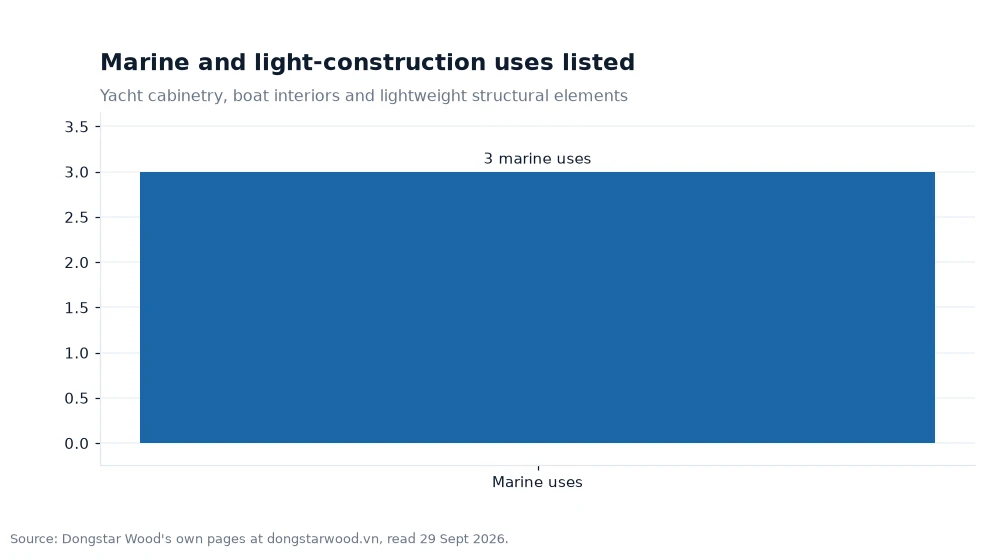
Three marine and light-construction uses are named: yacht cabinetry, boat interiors and lightweight structural elements. Beyond those, the range covers furniture such as chairs, tables, cabinets and wardrobes; interior panelling including wall cladding, ceiling panels and partitions; and architectural work such as doors, trims and decorative accents.
A supplier able to talk about all of those applications is normally pressing for several of them. Contracting with an Okoume Plywood Supplier that publishes its compliance and finishing detail means the technical questions can be settled from documents rather than from samples alone.
Cutting lists and what to do with off-cuts
A cutting list is the least expensive optimisation available in a joinery shop. Group components by size, nest them on a sheet drawing before any panel is cut, and send that list with the enquiry so the formats quoted match the parts you are making. Off-cuts wider than about 300 mm are worth keeping flat on a rack, because they cover the small curved brackets that otherwise consume a fresh sheet.
Where a job mixes curved and flat components, cut the curves first and use the remainder for flat panels. Curved parts want the cleanest area of the sheet, while a flat door panel will accept an off-cut with a repaired edge without anyone noticing once it has been banded.
Frequently asked questions
Is okoume strong enough for structural work?
It is used for lightweight structural elements and interior joinery rather than for heavy load-bearing panels. Where stiffness matters, keep the okoume face and add stiffness with framing or a second skin, instead of moving to a thicker sheet that will not form the curve.
Why does okoume take paint better than some hardwood plies?
Because the face is uniform and relatively free of the strong grain contrast that shows through a thin paint film. That uniformity, combined with a smooth calibrated surface, means the primer and topcoats cover the pink tone evenly.
What documentation should accompany a European order?
Ask for the CE EN13986 documentation together with the glue declaration for the panel supplied, which will name E1 or E0 low-emission bonding where that class was specified. Keep both in the project file with the timber origin statement.
Matching okoume to the rest of the order
If a project mixes species, decide which faces are seen together before ordering: the birch panel range gives a light cream face that suits painted or clear-finished components, while okoume brings the pink tone that many marine interiors are built around. The manufacturer's profile page is the place to check capacity and certification before the first container is booked.
Characteristics, compliance detail and application lists in this article come from the supplier's website, viewed on 29 September 2026 and carried into these notes and carried into these notes for the numbers in this article[1].